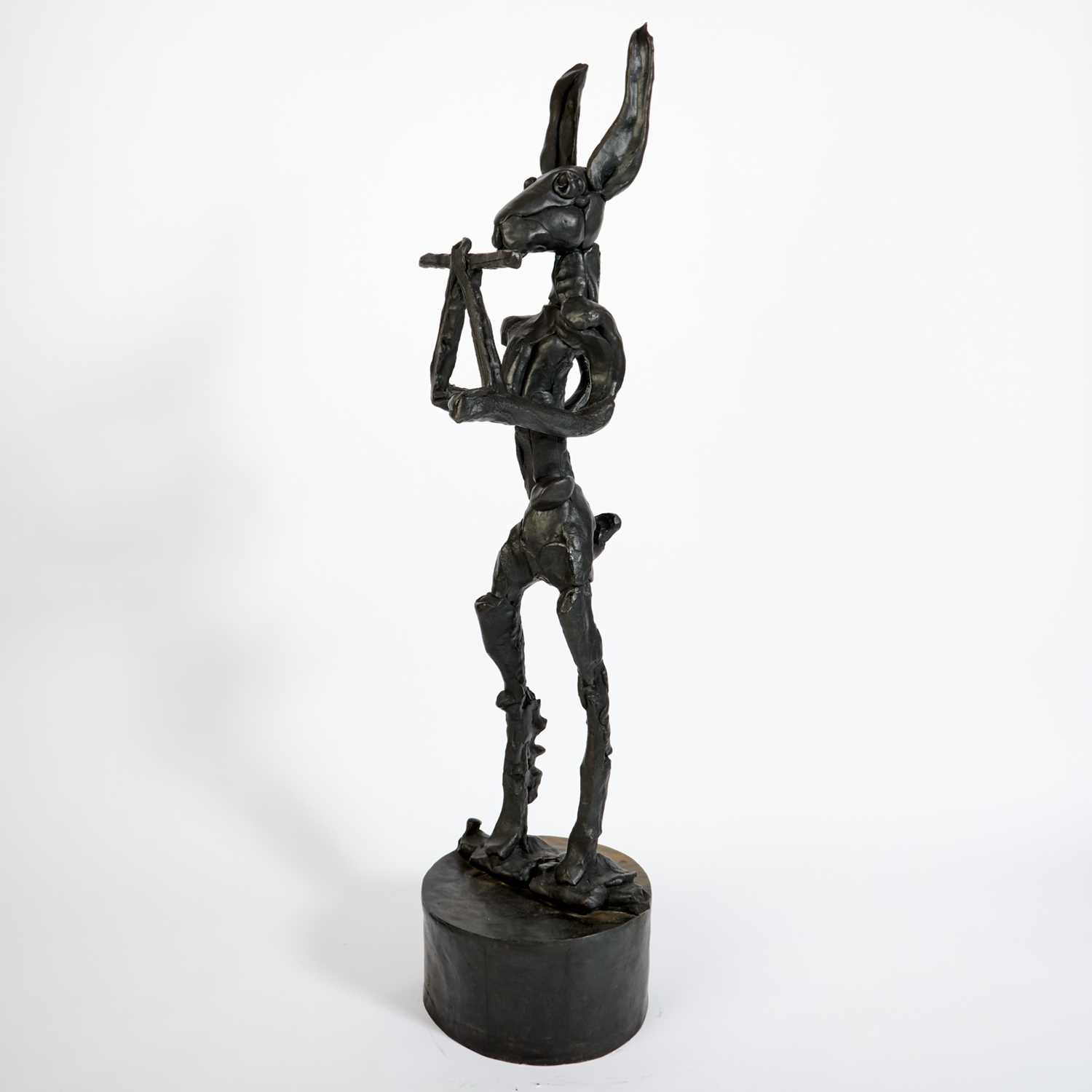
Barry Flanagan
British, 1941-2009
Barry Flanagan was born in Prestatyn, North Wales, and initially studied architecture before shifting his focus to sculpture at Saint Martin’s School of Art in London, where he graduated in 1966. He later taught at both Saint Martin’s and the Central School of Arts and Crafts, emerging as a key figure in the generation that redefined British sculpture in the 1960s.
Flanagan’s early work broke sharply with tradition, employing materials like sand, rope, and hessian to question permanence, weight, and volume. These ephemeral constructions challenged the conventions of sculptural form, aligning him with the broader conceptual movements of the period. In the late 1970s, Flanagan turned to bronze, a material he had once resisted, and began developing the now-iconic series of leaping hares. These dynamic figures came to embody his unique blend of wit and classical craft.
His international reputation was solidified when he represented Britain at the 1982 Venice Biennale. Today, his monumental bronzes can be found in public spaces and museum collections around the world, celebrated for their energy and imaginative spirit.
Flanagan died in Ibiza in 2009. His legacy lies in the way he bridged the experimentation of postwar sculpture with a renewed commitment to figuration, offering a body of work that remains both intellectually rigorous and visually engaging.